How to Warm Your Email List
Table of Contents Jump to:
Jump to:
Table of contents
To warm your email list, start with a send to 50 subscribers, then a send to the next 150. From there, size each new segment by adding the two before it together: 200 (50 + 150), then 350 (150 + 200), then 550 (200 + 350), and so on, spaced 48 to 72 hours apart. This slow ramp rebuilds trust with inbox providers before you increase your regular sending volume.
Clean out subscribers who haven’t engaged in a long time before you start, then warm your list if one of the situations below applies to you. If you skip warming, you’re sending a full-volume blast to an inbox provider that has no recent reason to trust you.
Who should warm their email list
Warm your list if:
- You’ve moved to a new email platform, since inbox providers treat new sending infrastructure as unproven
- You’ve recently authenticated your domain
- You haven’t sent an email in over six weeks, since your domain reputation cools off with inactivity
- You’re ramping up your sending volume for a launch, such as ahead of Black Friday
- You’re not getting the results you want from your regular sends
Why list warming works
Inbox providers like Gmail, Yahoo, and Outlook decide where your email lands based on your sending habits, not your subject line or your design. When you send to a large group and only a fraction opens, that tells the provider your content isn’t valuable, and your next sends get buried or filtered.
Warming flips that signal. You start with the people most likely to open and click, so the provider sees a healthy pattern from the first send. Each larger segment builds on that trust, which is what lets you keep expanding your reach without tripping a spam filter.
This only works as a follow-on step, not a replacement. Make sure your sending domain is authenticated and your list is clean of subscribers who haven’t opened, clicked, or purchased in months before you start warming. Warming a list that still has cold contacts on it doesn’t work as well, as inbox providers pick up on the lack of engagement.
Step 1: Build an email worth opening
When you warm your list, you’re going to send the same email to small segments of your audience. This warming email needs to earn the open and the click, since both signal to inbox providers that your content is valuable.
Skip subject lines and content like “Do you still want to hear from me?” or “Is this goodbye?” They consistently underperform, because they ask subscribers to do work instead of giving them something they want.
Give people a real reason to open instead: early access to a freebie, a resource you haven’t announced publicly yet or the return of a newsletter after time away. Make sure that reason is genuine, not something you’re only sending to test deliverability.
Keep the email evergreen, too. You’ll send it to different segments over several days, so avoid anything time-sensitive, like a deadline that’s already passed by the time your later segments receive it.
Step 2: Build your warming segments
Sort your active subscribers by last activity, then start with your top 50. That’s segment one, regardless of whether your full list is 500 subscribers or 500,000. Segment two is the next 150.
From there, size each new segment by adding the two before it together. Important: each segment is created with unique subscribers. A single subscriber should not be in more than one warming segment.
- Segment 1: 50 subscribers, running total 50
- Segment 2: 150 subscribers, running total 200
- Segment 3: 200 subscribers (50 + 150), running total 400
- Segment 4: 350 subscribers (150 + 200), running total 750
- Segment 5: 550 subscribers (200 + 350), running total 1,300
Keep going with the same math for as many segments as your list needs. The sequence compounds quickly: by segment 10 or 11, most lists are back to full volume.
In Flodesk, go to your Audience tab, filter to active subscribers, and sort by last activity. Select subscribers in batches, add each batch to its own segment (50 subscribers into “Warming segment 1,” the next 150 subscribers into “Warming segment 2,” and so on), and repeat until you’ve included your full active list in a segment.
Step 3: Schedule sends 48–72 hours apart, and watch them
Send the same warming email to each segment, spaced 48–72 hours apart. Schedule them as individual campaigns, not a workflow. A workflow runs on its own and won’t show up on your calendar, and warming is a process you want to watch closely, not automate.
Check your open and click rates after each send before the next one goes out. If a segment underperforms (below 35% open rate), pause the schedule and hold off on the next batch rather than sending into a pattern that’s already trending down. If this happens, it might be best to clean your list again with stricter criteria.
Step 4: What do you do after warming?
Once your last warming segment has sent, you’re not quite ready to go back to your full list yet. Filter for any subscriber who was in a warming segment but didn’t open the warming email, and move them into a new segment called “Did Not Engage in Warming.” These are the subscribers who stayed cold through the whole process, and they should stay out of your next send too.
Schedule one more email, with brand new content, to your full active list, excluding the “Did Not Engage in Warming” segment. This is the bridge between warming and your regular sending volume, bigger than any single warming segment but not yet your full list.
Once that email goes out, you can go back to sending to your full list. From there, keep cleaning your list regularly, at least once a month, so it doesn’t drift cold again.
What warming actually does to your numbers
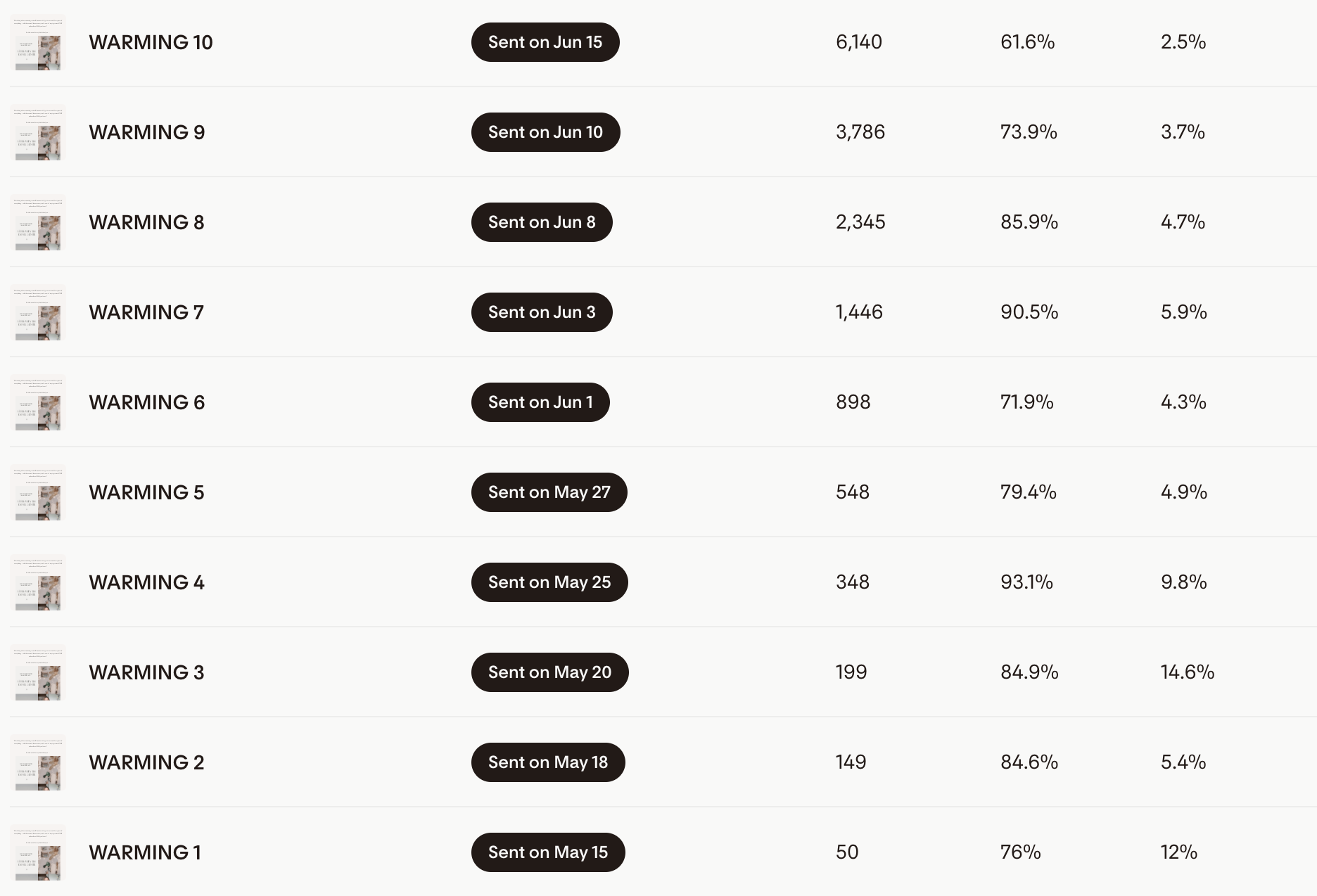
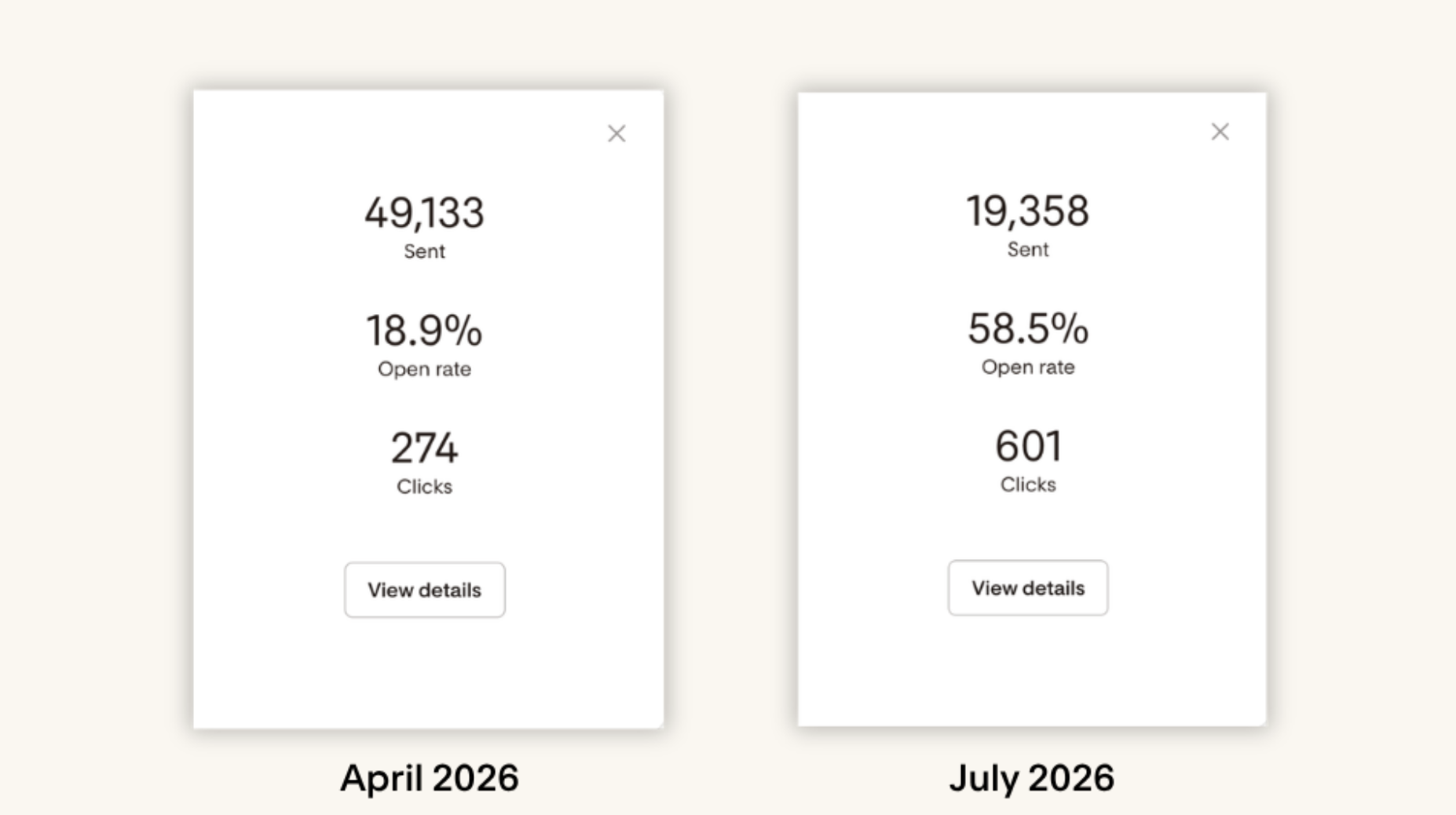
One Flodesk member came to us sending to roughly 50,000 subscribers with an open rate under 20% and a click rate around 0.5%. After cleaning close to 30,000 unengaged contacts off her list, she built out warming segments and scheduled them 48–72 hours apart.
Her first warming send, to her top 50 most engaged subscribers, opened at 76%, up from her 18.9% baseline before she started. Trust kept building as her segments grew. Her second send, to 150 subscribers, held at 84.6% opens. Her third, to 200, climbed to nearly 85% opens with a 14.6% click rate, the strongest of the whole sequence. From there, as she moved into segments in the thousands and reached colder, less recently engaged subscribers, her rates began to taper as expected. By the time she was back to sending at full volume, her open rate had settled around 61.6%, still more than double where she started and far beyond industry average.
The percentages tell part of the story, but the number that matters most is what happened to her actual clicks. In April 2026, before she cleaned and warmed her list, she sent a promotional email to her full audience. That July, the same type of email went out to 30,000 fewer people, and it still earned more than double the clicks, about 600 total, over 300 more people clicking than the April send got. Fewer recipients, more real people clicking.
The math doesn’t change whether your list is 500 people or 50,000. Start with a small, engaged segment, and move to the next, larger one once a send performs well.
Warm your list before you need it
Warm your list in the weeks before you need it, not the week of. That gives inbox providers time to trust your sending pattern, so your campaign is more likely to land in the inbox instead of spam.
Ready to warm your list?
Log in to Flodesk and build your first warming segment.
Frequently asked questions about warming your email list
List warming is the practice of sending an email to a small, engaged segment of your subscriber list first, then repeating that send to progressively larger segments over time. It rebuilds trust with inbox providers like Gmail and Yahoo before you return to your regular sending volume.
Start with a send to 50 subscribers, regardless of your total list size. Sort by last activity and select your 50 most recently engaged subscribers as segment one. Segment two is the next 150.
Add the sizes of the two previous segments together. After 50 and 150, that produces 200, then 350, then 550, and so on, compounding until you’re back to your full sending volume.
Space each send 48–72 hours apart, and check engagement after each one before scheduling the next. Don’t set the full sequence and walk away.
You can, but it’s not recommended. Flodesk recommends you schedule warming emails as individual sends rather than a workflow. Workflows don’t appear on your calendar and are harder to pause, and warming depends on being able to monitor and stop the sequence if engagement drops.
Warm your list if you’ve moved to a new email platform, recently authenticated your domain, haven’t sent an email in over six weeks, are ramping up your sending volume for a launch, or aren’t getting the results you want from your regular sends.
Give people a real reason to open it, not a check-in about whether they still want your emails. A freebie preview or a returning newsletter both work well. Keep it evergreen too, since different segments will receive it on different days.